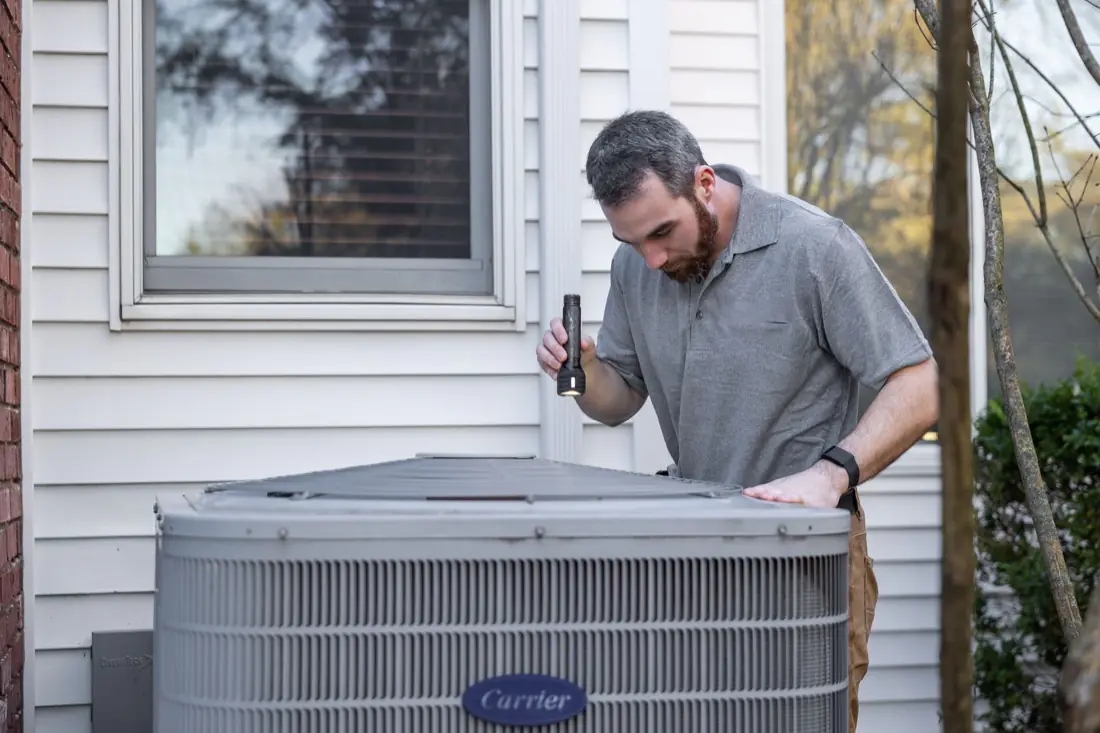
Web design for HVAC companies has a problem most trades do not: two completely different buyers on one site. The person whose heat died tonight wants a phone number and nothing else. The person replacing a system in spring wants brands, financing and proof. One page cannot lead with both.
The fix is not a bigger site. It is deciding which visitor the top of the homepage belongs to, and giving the other one a clear door of their own.
The two visitors, and who gets the top of the page
Emergency wins the top. It is the more urgent decision, it is decided fastest, and the person making it will not scroll. Replacement buyers research for weeks and are perfectly willing to look for the page that speaks to them.
What each visitor needs from you
| What they need | Emergency call tonight | Replacement in spring |
|---|---|---|
| First thing they look for | A phone number that dials | Brands and options |
| How long they spend | Under a minute | Days or weeks |
| What convinces them | You are open and you cover them | Proof, financing and a real quote |
| Where they should land | The top of the homepage | A page built for the decision |
Both of these are on every HVAC site I build. The difference is which one the homepage opens with.
What goes above the fold
- Phone number, tappable, on every page. At 2am nobody fills in a form. If the number is not a link, it does not exist.
- Emergency hours stated plainly. 24 hours, or until 9pm, or next morning. Say which, and say what a callout costs if it differs.
- The towns you cover, written out. People search their own town. A radius on a map does not answer the question they are asking.
- Heating and cooling both named. Somebody searching in July needs to see cooling in the first line, and in January the opposite.
The replacement page, which is where the money is
A repair call is worth a callout fee. A system replacement is worth thousands, and the buyer takes far longer to decide. That deserves its own page, and most HVAC sites do not have one.
- The brands you install. People shop by brand whether or not that makes sense. Name them.
- How a quote works. Do you visit, is it free, how long does it take. Removing that uncertainty is worth more than any design change.
- Financing, if you offer it. Say so plainly and say who provides it. If you do not offer it, say that instead of staying silent.
- Photographs of installs you have done. Your own work, in houses that look like the ones in your area.
Maintenance plans deserve better than a footer link
If you sell a maintenance or service plan, it is the most valuable thing on the site, because it is the only part of the business that repeats. Give it a page, put the price on it, and say exactly what a visit includes and how many there are a year. Plans lose sales to vagueness far more often than to price.
What an HVAC website should cost
Five pages covers most HVAC companies: home, repair, replacement, maintenance plans and contact. That is $449 at my prices, with the copywriting and the technical SEO included, live in seven days.
Commercial work usually justifies a sixth page, because it is a different buyer with different questions. Anything past that tends to be pages built for search engines rather than customers, which ages badly. What each tier includes is on the what every build includes page.
A site that flips with the season
HVAC is the only trade where half your service list is irrelevant for six months of the year. In January nobody is searching for air conditioning, and in July nobody cares about your furnace work.
You do not need two websites. You need a homepage where the top section can be swapped twice a year, and separate pages for heating and cooling underneath that stay up permanently and keep collecting search traffic all year. Swapping the homepage takes ten minutes. Doing it twice a year is one of the highest value edits you will ever make to the site.
Financing, and what silence costs
A system replacement is thousands of dollars, and a large share of the people reading that page cannot write that cheque today. Financing is the thing that decides whether they call you or keep nursing a dying unit for another year.
If you offer it, say so on the replacement page, name who provides it, and say what the application involves. If you do not offer it, say that too. The silence is worse than either answer, because it reads as a price you are hiding rather than a payment option you lack.
Commercial work, and whether it deserves a page
If you do commercial work, it needs its own page. A property manager and a homeowner are not the same buyer and they are not reassured by the same things.
The homeowner wants to know you will be careful in their house. The commercial buyer wants response times, contract terms, whether you can service what they already have, and whether you can invoice properly. Those are different pages, not two paragraphs on one.
What to connect instead of build
- Your scheduling tool. If you already use one, the site should link to it, not replace it.
- Your review profile. Point at it. Do not retype the reviews and do not summarise them into a rating you cannot show.
- Payment links. If you take card payments or deposits, that is a link, not a checkout that needs building.
- Your phone system. Whatever the number is, it should be a link on a phone, and it should be the number that actually gets answered at 2am.
Naming the towns you cover
Write the towns into the copy on the homepage and the two main service pages. Skip the page per town approach unless you can write something genuinely different about each one, because a dozen near identical pages does more harm than the handful of searches it might catch.
Knowing which jobs came from the site
Most HVAC companies have no idea whether their website produces work, which makes every decision about it a guess.
Two things fix that and both are free. Track phone taps and form submissions in analytics, so you can see how many people did the thing you wanted rather than just how many visited. And ask on the first call how they found you, then write the answer down. That single question, asked consistently for a month, tells you more than any dashboard.
- Phone taps tracked. Every tap on the number recorded as an event, so you can compare months honestly.
- Form submissions tracked. Same, and it doubles as an alarm when the form silently breaks.
- A note on every call. How they found you, in four words. A month of that beats a year of guessing.
- Seasonal comparison. Compare January to January, not January to July, or you will draw the wrong conclusion twice a year.
One more thing worth building into the site from day one: a plain sentence saying what happens after somebody submits the form. Called back within the hour during business hours, next morning otherwise, whatever is true for you. Emergency buyers are deciding between you and the next result, and the company that says when it will call back wins more of those than the company that says nothing.
What to take away
- Emergency owns the top of the homepage. It is the faster decision and the visitor will not scroll to find you.
- Replacement needs its own page. It is the biggest job on your price list and the longest decision. It cannot live in a paragraph.
- Maintenance plans are worth a page and a price. They are the only repeating revenue on the site, and vagueness is what kills them.
Questions people actually ask
What should an HVAC website include?
A tappable phone number and emergency hours at the top, the towns you cover written out, separate pages for repair and replacement, your maintenance plan with its price, and photographs of your own installs.
How much does an HVAC website cost?
Most HVAC companies need about five pages, which is $449 at my prices, including all the copywriting and the technical SEO, live in seven days with no monthly hosting fee.
Should heating and cooling have separate pages?
Usually yes, because people search seasonally and a page about one job beats a paragraph about both. Make sure whichever is in season is visible on the homepage.
Is a maintenance plan page worth building?
Yes. It is the only repeating revenue most HVAC companies have, and plans are far more often lost to a vague description than to the price.
Should my HVAC homepage change with the seasons?
Yes. Swap the top section twice a year so heating leads in winter and cooling leads in summer, and keep permanent pages for both underneath. It takes about ten minutes and it is the highest value edit on the site.
Do I need a separate page for commercial HVAC work?
If commercial is a real part of your business, yes. Property managers ask about response times, contracts and invoicing. Homeowners ask whether you will be careful in their house. One page cannot answer both well.

Danny Ruiz
I build small business websites on my own. The design, the copy, the SEO and the hosting setup, all of it. One person, fixed prices, live in seven days.
Read next
Trades
Web Design for Plumbers That Gets You the Call
The thirty second version of your site that decides whether the phone rings.
8 min read
Trades
Web Design for Contractors That Turns Photos Into Leads
Turning a camera roll into project pages that book work.
8 min read

Pricing
Website Design Packages Pricing, With Real Numbers Attached
My full price list, what counts as a page, and what is deliberately left out.
8 min read